There are a number of benefits to shopping at a local farmers market for the farmers, the consumers, as well as for the greater community. These benefits fall into three main categories: mercantile, social, and civic. First, the farmers are benefited because they receive the opportunity to enter their products into the market, with instant and direct feedback from the consumers (Kelly and Leean). It is also very profitable for the vendors because they are able to accrue more rapid income on the day of the market. Ideally, the market is in an area that would also prompt shoppers to explore local businesses and shops within walking distance, to further boost small businesses and thus the local economy. Next, the consumers are able to receive fresh, locally produced food as well as develop relationships with the farmers. There is a certain degree of loyalty that is cultivated between the farmer and the customer that keeps these consumers coming back to support local farmers week after week. Furthermore, there is an important social benefit in that farmers markets encourage a friendly, social environment and welcoming atmosphere that would not be encountered when shopping at a local grocery store, for contrast. When shopping at a farmers market, a consumer averages experiencing between 15 and 20 social interactions compared to only 1 to 2 when shopping at a grocery store (“Cultural Significance”). Finally, markets have a civic benefit in that they can be a platform for educating people in the community about food policy issues and stressing the importance of healthy eating, especially in passing this down to the youth (“Cultural Significance”). Because there is such an abundance of farmers markets in the Richmond area, it is very likely that there is one within a reasonable distance, and thus many members of the community are able to partake in this experience.
Beth Furguson, the executive director of the organization Real Local RVA, has some information and insight on the significance of farmers markets to the Richmond community. This organization is one who’s “mission is to educate, support, and raise awareness of the local food movement and choices in the Greater Richmond area” (Furguson). They support farmers markets, small grocery stores, and encourage consumers to buy local food. When I inquired about the role of farmers markets in the Richmond community, Furguson highlighted multiple benefits for and facets of the community in saying: “They are social centers, places where relationships are built, and communities are sustained. They provide a place for farmers to sell directly to consumers, bypassing all of the wholesale markets, and allowing farmers to get the maximum amount possible for their food” (Furguson). The full transcript of Furguson’s responses can be seen on the Appendix page.
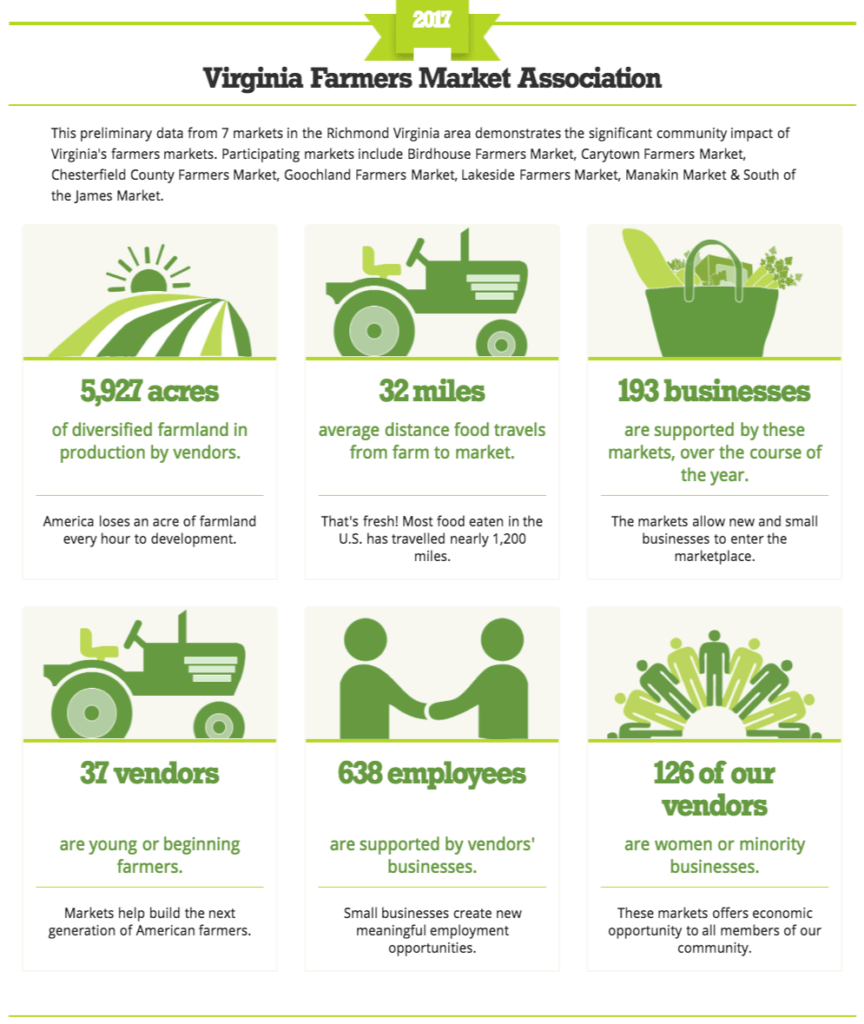
Furthermore, I was able to get in contact with Mary Delicate, who works with the Virginia Farmers Market Association. She was able to provide me with a website that compiled data in 2017 to try to measure the impact of farmers markets in Richmond. A graphic displaying this information can be seen below. Some highlights of this data include the fact that these markets support 193 businesses, and 32 miles is the average distance travelled to arrive at the market, illustrating that the food is fresh.
 Farmers Markets and Cities