Throughout the history of Virginia, Richmond was consistently a very important urban center for the state. Because of the early agricultural based economy of the state, the cities of Virginia grew at a much slower rate when compared to other states. Specifically, much of the growth of these cities occurred during and after the Civil War. By 1860, Richmond, along with other cities such as Norfolk and Alexandria, recorded populations greater than 30,000 (“Urbanization in Virginia”). Furthermore, the establishment of railroads along with other developments of the Industrial Revolution affected the development of Richmond and other cities in Virginia, with regards to transportation. Additionally, Richmond became a center for the production of cigarettes, which was a key development in the increasingly industrial, factory-based economy of the city. Another key technological advancement that affected the urbanization of Richmond was the introduction of the electric streetcar in 1888 (“Urbanization in Virginia”). The image below shows a street in downtown Richmond in 1924 and features the electric streetcar. This development allowed the land surrounding the city to become more available to populate with residential neighborhoods. The downtown urban area became a place where people typically worked, while the surrounding suburbs became areas where people lived. This suburbanization and “white flight” became even more common following World War II. Finally, by 1990, “more than 80% of Virginians resided in the state’s 41 cities and 188 towns” (“Urbanization of Virginia”). Clearly the growth and development of cities in Virginia, like Richmond, affected the work and social lives of its residents. Likewise, it impacted agricultural practices and the emergence of farmers markets.
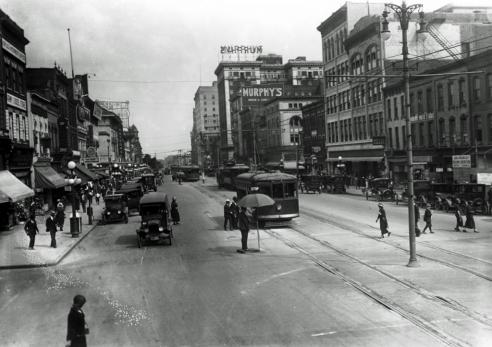
https://www.virginiahistory.org/collections-and-resources/virginia-history-explorer/urbani
zation-virginia.
The urbanization of Richmond in particular was able to positively impact farmers and thus gave rise to farmers markets in the city. Generally, urbanization is associated with the evolution of diets of a population. For instance, people residing in urban areas tend to buy more expensive and more nutritious food, which would include meat and dairy items (“Growing Food”). Furthermore, according to the Chicago Council on Foreign Affairs, “urbanization represents an enormous opportunity for small-scale farmers to expand their production and generate a sufficient livelihood,” displaying that urbanization of cities such as Richmond was able to serve as a benefit for farmers (“Growing Food”). Before and after the Civil War, cities in Virginia “served as markets for local agricultural produce and provided manufactured goods in return” (“Urbanization in Virginia”). Thus the growth of cities like Richmond can also be linked to the growth of farmers markets in a sense.
 Farmers Markets and Cities